Taking Time to Count the Roses: The Rosary (Part III of Roses in Tattoos and Magic)

(Trigger Warning: Catholicism)
Before I talk about the rosary, here's an explanation for those who are surprised, annoyed, or even triggered to see so much Catholicism in a blog that is purportedly about magic and tattoos:
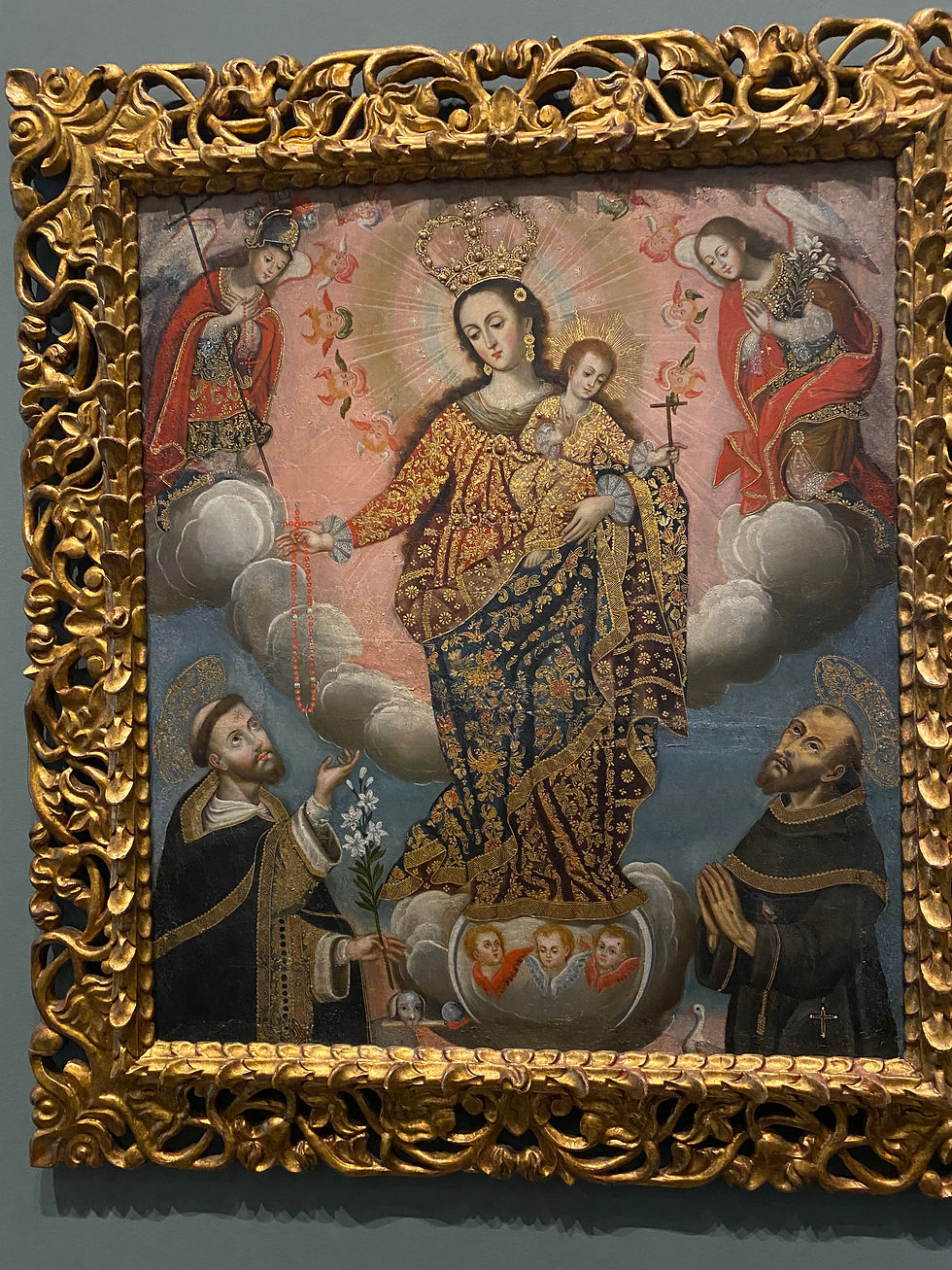

Catholicism is like a giant amoeba. It bubbled out of the deep cultural exchange that occurred in Hellenic Alexandria, slurping up and incorporating motifs and symbols from Greek, Hebrew, Egyptian, and Near Eastern magic, and continued to engulf and swallow cultural influences as it extended its pseudopods into Europe, sub-Saharan Africa, and the East. Wherever it oozed in its mission of world digestion, the people already living there (or, later, dragged there by the colonial project) it sucked up the existing magical and spiritual practices of the people already living there and regurgitated them back up in a Catholicized form (aka syncretization). And in spite of the Inquisition, forced conversion and the whole rest of it, all of this richness is still alive in the churning protoplasm of this amoeba. Protestantism did its darnedest to exorcise all of these spirits, throwing the baby out with the bathwater in its effort to strip Christianity of its excesses. But around the Mediterranean, on the Iberian peninsula, in Africa, and in the Caribbean and Latin America, those gooey, stew-y connections between Catholicism and layered pantheons of local and/or preexisting spirits and practices remain. My ancestors came from these places. I’m pretty sure it’s their fault that I can’t stay away from Catholicism.

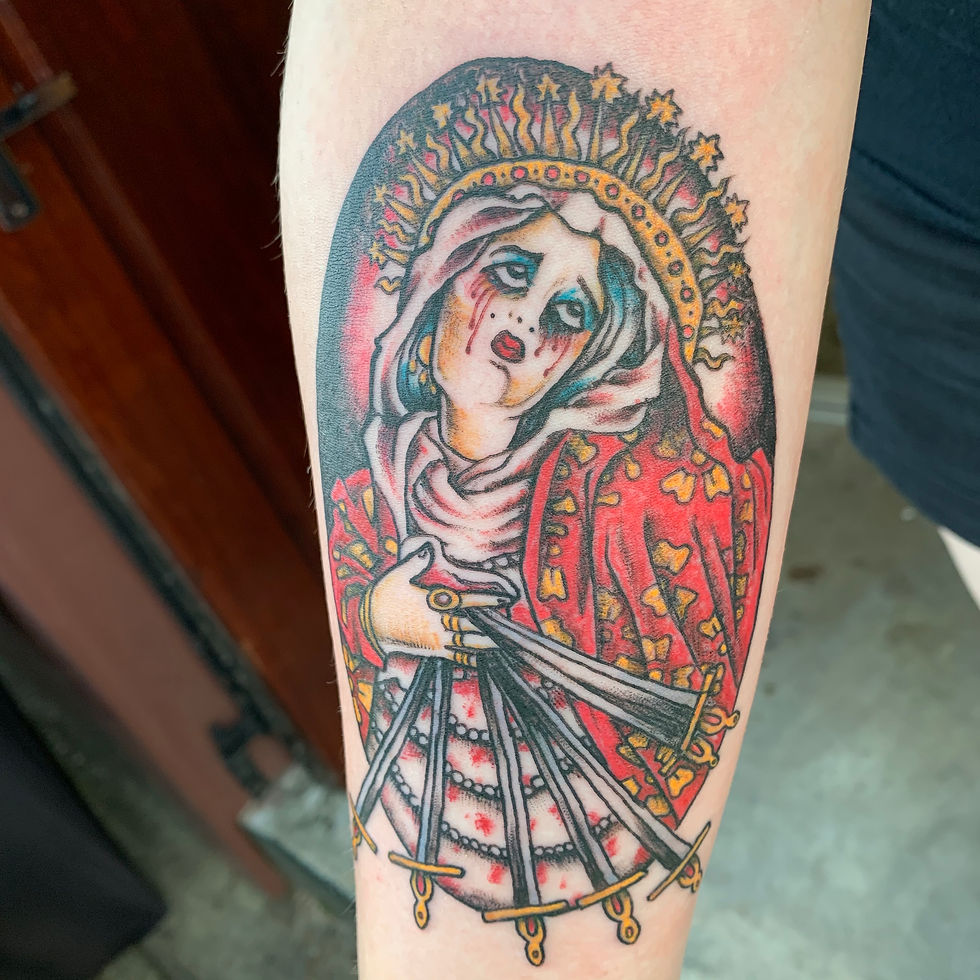
Ancestral influence is my only explanation of how very very deeply and inescapably Catholic I personally am while also owning a tattoo and occult shop and seeing zero contradiction between the two. I feel at home within Catholic ritual, symbolism, iconography, saints, rote prayers, and so forth. It is my magical language. Granted, I grew up without it, my hippie mother having lapsed after a traumatic Catholic upbringing and indoctrinated me into Beatles fandom instead. Thanks to that, I did not experience the childhood trauma around Catholicism that drives so many away from the religion.
But I know many have. And I’m sorry. As an amoeba, the Church contains many paradoxes. The harm done by the entanglement of repression, empire, colonialism, and patriarchy with Catholicism numbs many to the beauty of its mystical language.
If you don’t want to read this one, I understand. You need to find the spiritual tradition that is healthy for you, and I’ll be writing about others in time. But if you’re okay with hearing about how one of the mainstays of Catholic prayer ties into the twining symbolic life of our botanical main character La Rosa, let the infodump begin!


Any good or bad Catholic, mall goth, or 80s Madonna wannabee will be familiar with the rosary, a string of a hundred and fifty beads at ten bead intervals with a bead between each, terminating in a hanging section that dangles a crucifix. In case you don’t identify as any of those, I'll explain what it is. The rosary counts prayers: specifically, repetitions of ten Hail Marys, interspersed with Our Fathers, Glory Bes, and sometimes Oh My Jesuses (if you’re nasty). The cycle revs up with the Apostles Creed, a convenient encapsulation of official church dogma (as opposed to a plurality of fascinating heresies) that has its origins in the second century. It wraps up with the crowning glory, in my opinion, of all Marian prayers, the Hail Holy Queen.
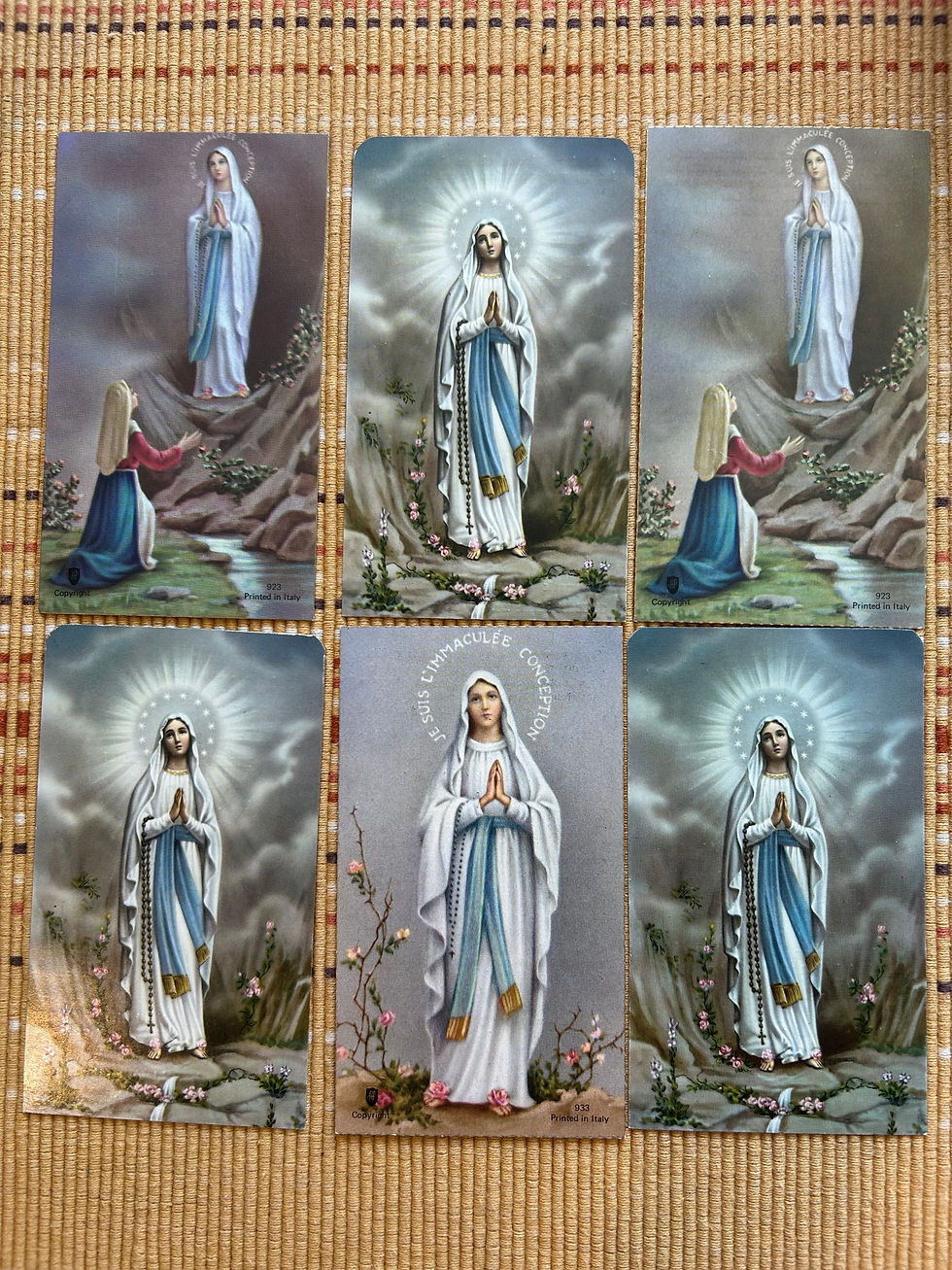
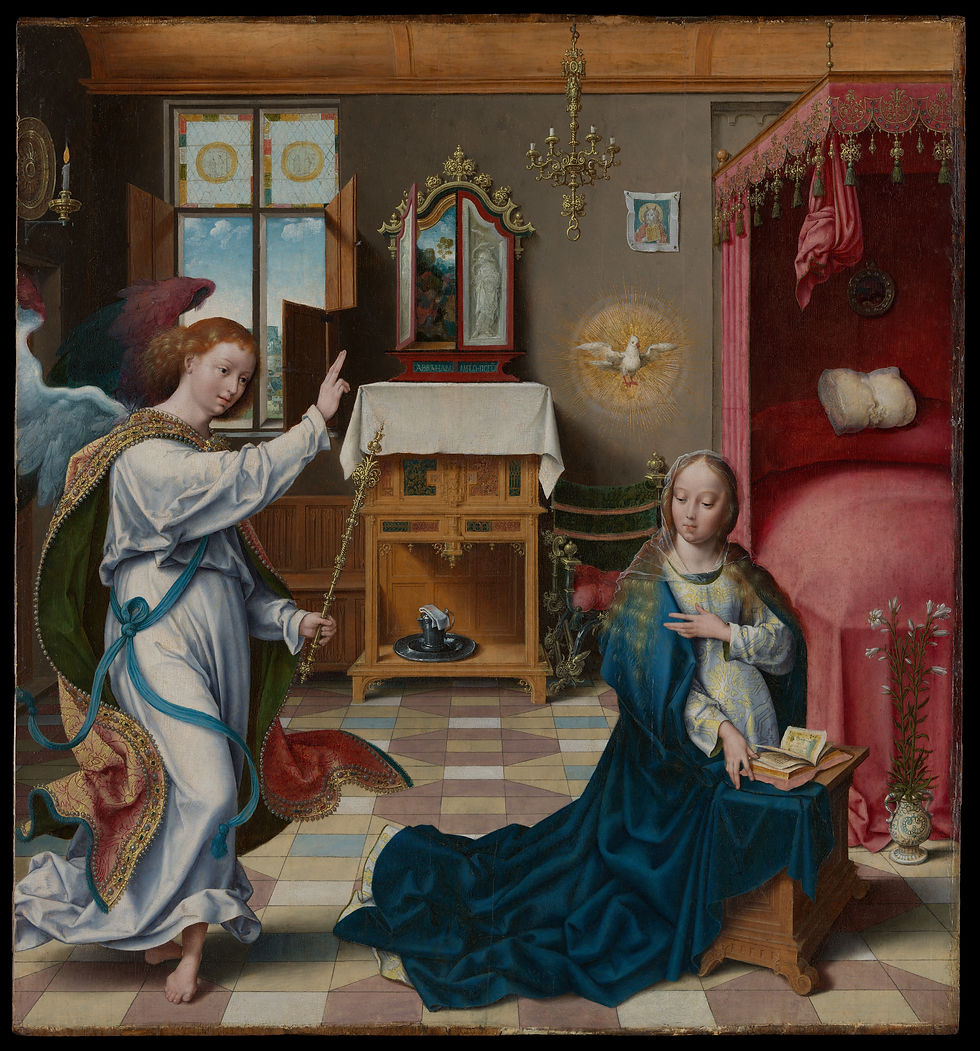
This set of rote prayers is a lot to memorize, but like that scene in The Cat and the Hat where he’s balancing on the beach ball, that is not all! While praying through each decade of the rosary, you hold in your mind a different divine mystery. These “mysteries” are moments in the life of Christ and/or Mary, such as the Crucifixion, the Transfiguration, the Annunciation, the Assumption, etcetera. But that is not all, oh no, that is not all! Depending on the day of the week, you pray your way through a different set of mysteries: on Mondays and Saturdays the Joyful Mysteries; on Tuesdays and Fridays the Sorrowful Mysteries; on Wednesdays and Sundays the Glorious Mysteries; on Thursdays the Luminous Mysteries. That’s twenty mysteries in total, and you have to remember them all in order!

Complete instructions for praying the rosary can be found here.
In my personal experience, this is a deeply moving, vision-provoking experience. As the Mysteries are mysteries, I don’t try to understand the process or deeper meaning, but surrender to the rhythms, repetitions, and images of the Rosary as I let the well worn words, spoken by Catholics the world over, slip through my lips and each bead slip through my hands. I have, and am wearing right now, a rosewood rosary given to me by my mother before she died. It holds in it all the rosaries I have ever said: during my own dark times, over spiritual baths made for others, in the church pews, before my ancestor altar, and at my bedside. Like any magical tool, it bears the signature of all of these repetitions, just as the spoken prayers themselves bear the signature of all who have said them through time and around the world. Power is accumulated in this way; the soft power of murmurs, of repetition, of the women’s work of stringing beads.
The word rosary itself comes from… roses! One legendary backstory I read about it goes like this: a young monk, faithful in his devotions but not very industrious (ohhhh, you neurodivergent mystics!), found himself alone in a forest rather than alongside his brothers in the monastery when it came time for daily prayers to the Virgin. There he knelt, between the trees on the mossy carpet, praying aloud. Unbeknownst to his ecstatic little brain, a gang of robbers surrounded him while he was lost in his devotions. The Virgin herself appeared, towering in statuesque splendor above her kneeling devotee. She proceeded to pluck a blooming rose from his mouth each time he completed a prayer, and worked it into a garland. Once strung together, the roses shriveled up, each one resembling a bead. By the end, she had a string of a hundred and fifty, to the fascination of the onlooking robbers. She tied it off, hung it around the monk’s neck, and disappeared. And voila! The rosary was born!

(I honestly wish that was the legend the Church supported, but sadly, the Church supports a version that is all about Mary appearing to Saint Dominic in the 1200s and telling him to use the beads as a spiritual weapon against the Albigensian heresy. Which is just annoying church behavior.)
This cycle of a hundred and fifty Hail Marys the little monk was uttering was known as a rosarium, or “rose garden.” In order to keep track of these prayers, following the example of the above legendary apparition, Renaissance monastics mashed and molded roses from their gardens into beads and strung them into strands of 150. These rosaries carried a powerful symbolic link to the Virgin Mary, who, being the representative of the Divine Feminine, inherited the ancient rose symbolism that wove through Inanna, Venus, and the unnamed lovestruck feminine narrator of the Song of Solomon.
(It's actually not agreed upon how far back rosary beads made out of real roses go, and I'm getting tired of trying to prove it. So let's just take that as a nice image. They do make them now.)
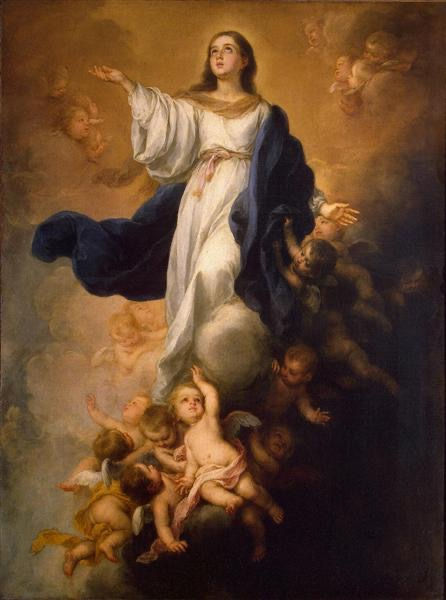
The modern rosary, despite the Our Fathers and Glory Bes, remains a predominantly Marian devotion. As we retrace all the steps of her son’s life, from his conception to his murder, resurrection and ascension, we’re meant to view it through the eyes of the mother that made it all possible, murmuring her praises all the while. She bookends the life of her child, both bringing him into being and mourning him. Her life encloses his, like the petals of a rose. Her story communicates all the emotional labors of motherhood: surrender to pregnancy, childbirth, worry and concern (when they lose him on their road trip because he stayed behind to preach), acceptance and support of his challenging adult self, and grief and surrender of losing him (which we probably all experience in some way, whether we lose them through death or they just grow up). Given that a disproportionate amount of attention is paid to his birth and death compared to what happened in between in Catholicism, you could say the story isn’t really about him at all (controversial take, I know). She’s the most invested witness to his life, which is a microcosm of the human condition (another controversial take, I know). She is the Great Mother, watching us all go through it, letting us dry our tears on her apron or wander back out into the world as needed. Maybe all our mothers- the good ones, the good versions of the maternal principle in our lives- are roses, we are the fruits they surrender when their blossoms fade, and the Mother herself is the rose bush, putting forth roses and fruits that put forth more roses and fruits ad infinitum.

That’s it for the rosary! Looking forward to next time!


I love this! TYSM for posting. And I love that you're comfortable with the esoteric as well as Catholic imagery. I love my rosary, too, and I think what really connected it to my yoga practice is the fact that the decades add up to one whole set of mala beads (108, or 9 x12, nine planets, 12 number of completion). I often pray the rosary for the same reason--the repetition. It's grounding. I didn't know about the Woodstock connection!! Too cool. I got reconnected with my rosary when I was at the shrine of Mother Angelica (the EWTN nun). I got a book about Caritas (nearby, but I never got there) about the rosary and prayed it for almost…